Tell us about the job
Takes about a minute. No obligation.
Sizing a furnace for this house starts with what the burner is actually asked to carry each winter. Homes in Riverside County, CA run heat about five months a year, from November through March. A contractor running a load calculation here has to account for a heating demand that falls consistently across those months, not in occasional spikes, which means an undersized unit runs long cycles and an oversized one short-cycles through its ignition system. Both failures show in the heat exchanger first. Getting the sizing right at installation is what determines how hard those components work every season the system runs.
Ductwork sized for an earlier generation of equipment shapes what a furnace installation actually involves in Riverside County. Half the homes in Riverside County, California were built in 1990 or earlier (2020-2024 ACS 5-year). That means a contractor arriving to install a new furnace is working inside a house whose existing duct layout was designed around different load assumptions, and what the ducts can actually carry has to be measured before the unit is selected. A house can accept the new furnace on paper and still require duct modifications to move the volume of air that furnace is built to deliver.
What Gets Installed With a New Furnace
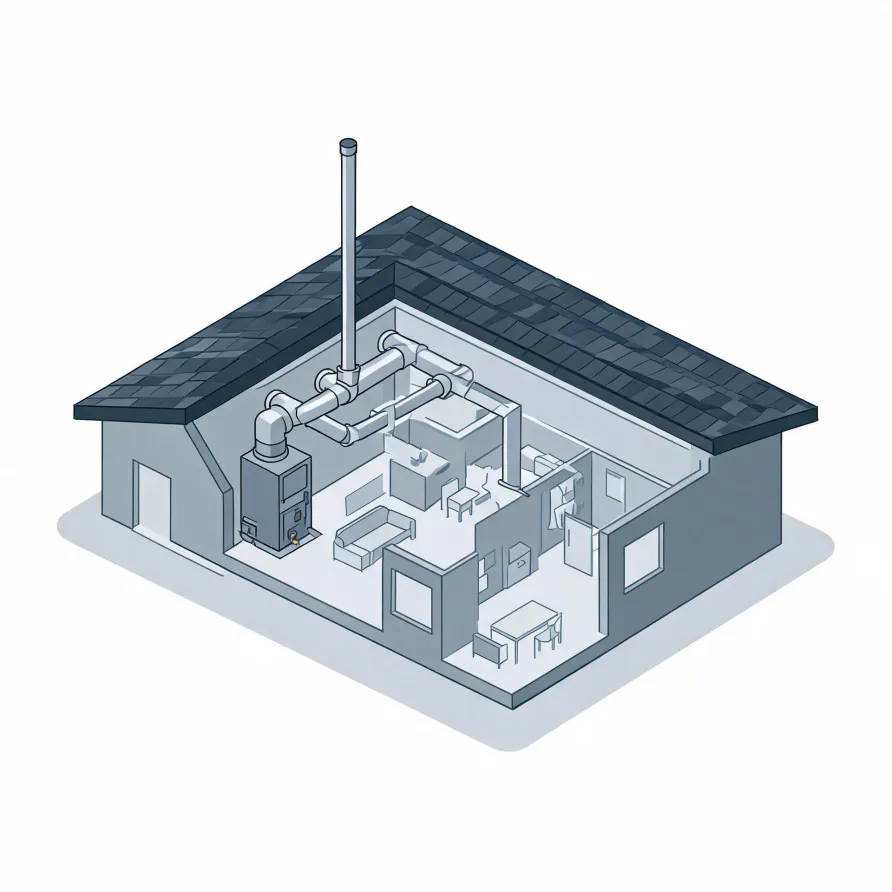
The furnace itself sits in a utility closet, basement, attic, or garage and is the unit a homeowner is most likely to have seen before. Inside it, a burner assembly ignites the fuel, a heat exchanger transfers that heat to the moving air, and a blower motor pushes the warmed air out into the home.
The flue pipe runs from the furnace to an exterior wall or through the roof, carrying combustion gases out of the house. Alongside it, the contractor installs a new filter housing and an air handler cabinet if the home uses a split configuration, each positioned to work with the supply and return air paths already in place.
The drawing shows a typical layout, and a licensed contractor determines which components and configurations apply to your specific home.
Find a contractor in Riverside CountyRiverside County, by the numbers
477 severe weather events were recorded in Riverside County, California between 2015 and 2024.
NOAA National Centers for Environmental Information, Storm Events Database, bulk CSV export, events 2015-01-01 through 2024-12-31.Half the homes in Riverside County, California were built in 1990 or earlier (2020-2024 ACS 5-year).
U.S. Census Bureau, 2020-2024 American Community Survey 5-Year EstimatesRiverside County, California holds 869,414 housing units (2020-2024 ACS 5-year).
U.S. Census Bureau, 2020-2024 American Community Survey 5-Year EstimatesOwners occupy 69.1% of the occupied homes in Riverside County, California (2020-2024 ACS 5-year).
U.S. Census Bureau, 2020-2024 American Community Survey 5-Year EstimatesFurnace Installation Rules & Codes for Riverside County, California5 sourced standards and regulations
What the Installation Actually Looks Like
Non-weatherized gas furnaces manufactured on or after November 19, 2015 must reach 80.0 percent AFUE.
Non-weatherized oil-fired furnaces manufactured on or after November 19, 2015 must reach 83.0 percent AFUE.
Mobile home gas furnaces manufactured on or after November 19, 2015 must reach 80.0 percent AFUE.
Non-weatherized gas furnaces manufactured on or after December 18, 2028 must reach 95.0 percent AFUE, up from the 80.0 percent minimum that applies to units manufactured before that date.
Licensing and Legal Requirements in Riverside County, California
California requires a state contractor license: it is a misdemeanour to engage in the business of, or act in the capacity of, a contractor in California without one, unless the work is exempt.
Severe Weather Events in Riverside County
Weather puts a measurable load on heating and cooling equipment, and that load varies by location. What Riverside County sees year to year shapes how hard a furnace has to work and how well it needs to be sized for the conditions here.
477 severe weather events, 2015–2024. Source: NOAA National Centers for Environmental Information, Storm Events Database.