Tell us about the job
Takes about a minute. No obligation.
Sizing a furnace for Mono County starts with understanding what the burner, heat exchanger, and ignition system are actually asked to carry each year. Homes in Mono County, CA run heat about ten months a year, from September through June. A furnace that is undersized, or one whose ductwork and combustion air supply were roughed in without a proper load calculation, cycles harder and more often through that stretch. The heat exchanger takes the worst of it. Contractors quoting a new installation here treat the load calculation as the first piece of work, because an equipment choice that would be adequate in a milder climate leaves this house short when the coldest weeks arrive.
Existing ductwork is what a contractor sizes and prices against before a new furnace goes in, and in Mono County that ductwork was built around equipment that has long since been replaced. Half the homes in Mono County, California were built in 1980 or earlier (2020-2024 ACS 5-year). Ducts routed for an older system carry the proportions, the layout, and the materials of whatever ran first, and a new furnace has to work within that or the contractor has to change it. The electrical service is the second variable. What those two things actually are in a given house is what the quote reflects.
What Gets Installed With a New Furnace
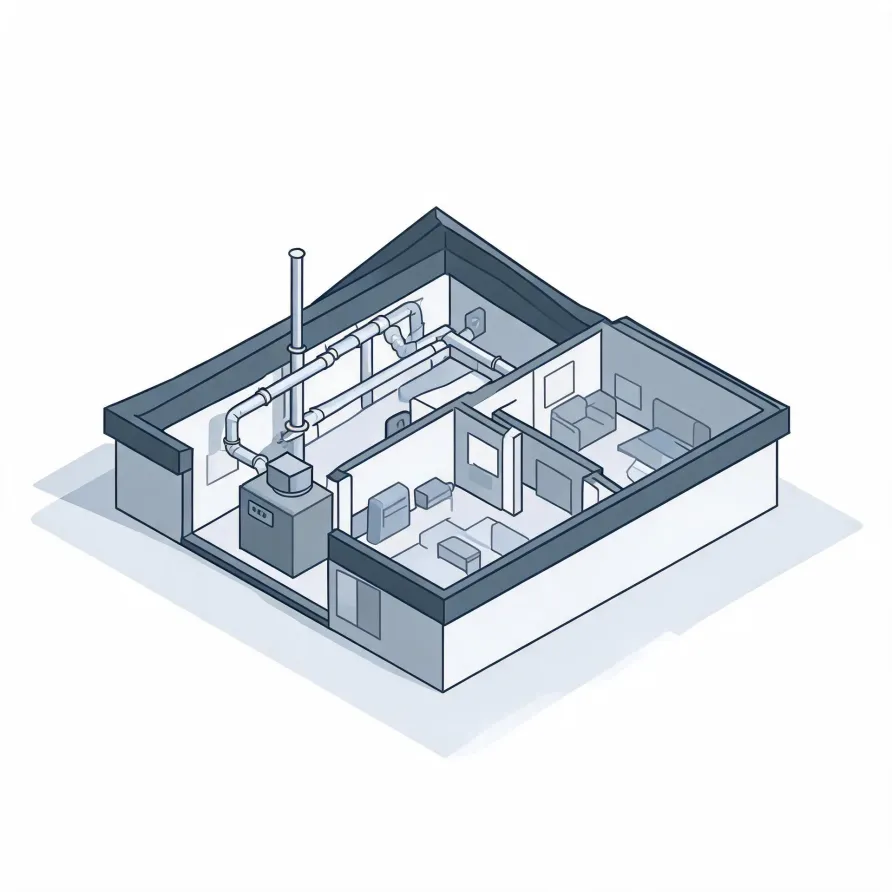
The furnace itself sits in a utility room, basement, or garage and is the unit that produces heat. A burner inside it ignites the fuel, a heat exchanger transfers that heat to the air stream, and a blower fan pushes the warmed air into the home. The flue pipe runs from the furnace to an exterior wall or roof and carries combustion gases out.
The thermostat mounts on an interior wall and is what the homeowner sets to call for heat. Low-voltage control wiring runs between it and the furnace to carry that signal. A condensate drain line also connects to high-efficiency models, routing any moisture produced during combustion away from the unit.
The drawing shows a typical layout, and a licensed contractor determines exactly what applies to your house.
Find a contractor in Mono CountyMono County by the Numbers
346 severe weather events were recorded in Mono County, California between 2015 and 2024.
NOAA National Centers for Environmental Information, Storm Events Database, bulk CSV export, events 2015-01-01 through 2024-12-31.Half the homes in Mono County, California were built in 1980 or earlier (2020-2024 ACS 5-year).
U.S. Census Bureau, 2020-2024 American Community Survey 5-Year EstimatesMono County, California holds 13,676 housing units (2020-2024 ACS 5-year).
U.S. Census Bureau, 2020-2024 American Community Survey 5-Year EstimatesOwners occupy 65.4% of the occupied homes in Mono County, California (2020-2024 ACS 5-year).
U.S. Census Bureau, 2020-2024 American Community Survey 5-Year EstimatesCodes & Standards Covering Furnace Installation in Mono County, California5 sourced rules and standards
What happens during an HVAC installation in Mono County
Non-weatherized gas furnaces manufactured on or after November 19, 2015 must reach 80.0 percent AFUE.
Non-weatherized oil-fired furnaces manufactured on or after November 19, 2015 must reach 83.0 percent AFUE.
Mobile home gas furnaces manufactured on or after November 19, 2015 must reach 80.0 percent AFUE.
Non-weatherized gas furnaces manufactured on or after December 18, 2028 must reach 95.0 percent AFUE, up from the 80.0 percent minimum that applies to units manufactured before that date.
Licensing and Legal Requirements in Mono County, California
California requires a state contractor license: it is a misdemeanour to engage in the business of, or act in the capacity of, a contractor in California without one, unless the work is exempt.
Severe Weather Events in Mono County
Mono County's climate puts real demands on heating equipment. Knowing the local weather record helps a contractor size and install a furnace that holds up to what this area actually delivers.
346 severe weather events, 2015–2024. Source: NOAA National Centers for Environmental Information, Storm Events Database.