Tell us about the job
Takes about a minute. No obligation.
A furnace running a full heating season puts its real load on the heat exchanger, the burner, and the ignition system. Homes in Kings County, CA run heat about six months a year, from November through April. By the time a homeowner calls for a repair in February or March, those components have been cycling daily for months. The igniter and flame sensor are the first things a contractor checks, because they fail under the kind of repetitive thermal stress this season produces. Cracks in the heat exchanger are a late-season find too, showing up only after sustained use has widened what was, at startup, a hairline.
Furnaces running in Kings County houses sit inside ductwork and wiring that was put in for something else and adapted over time. Half the homes in Kings County, California were built in 1986 or earlier (2020-2024 ACS 5-year). When a contractor opens a furnace here, the question that decides how the job goes is whether the parts that system takes are still in production. Replacement components for equipment fitted into an older house can be scarce, and a contractor who cannot source a part on the first try has to find a compatible substitute or source from a specialty supplier, which is where the job stretches.
The Parts of a Furnace a Contractor Checks First
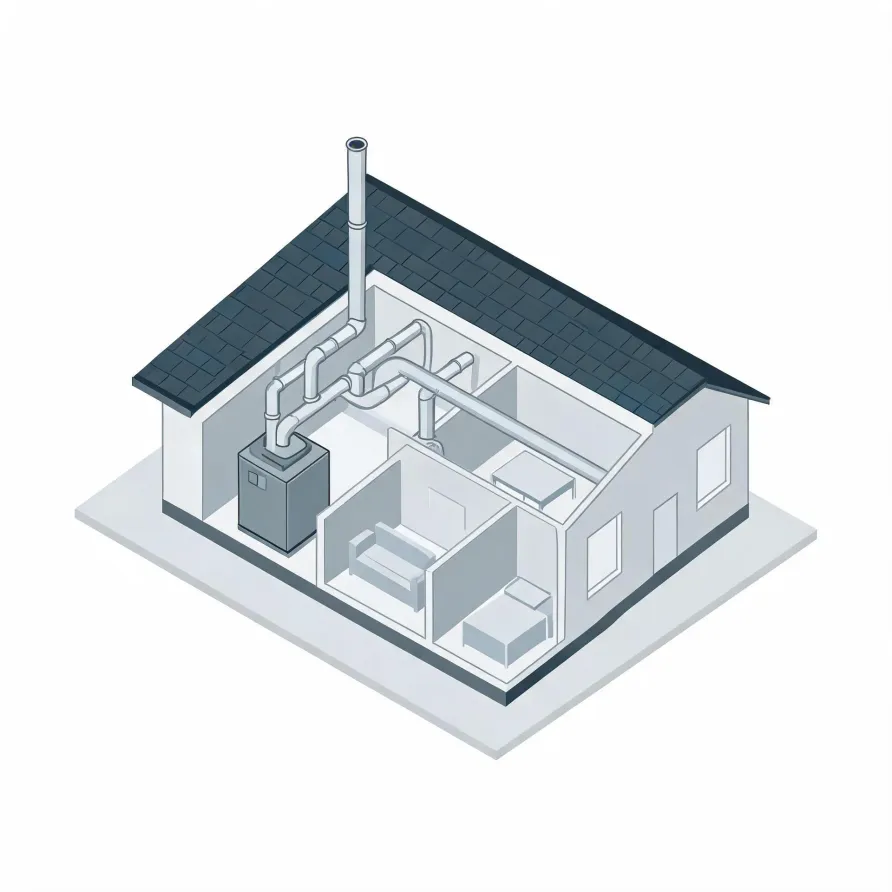
The heat exchanger sits at the core of the furnace cabinet and is where a contractor looks early. Cracks or buildup there disrupt the whole system. The burner assembly sits just below it, and when ignition is slow or incomplete, that is where the problem usually lives.
The blower motor and its wheel sit in the lower cabinet section and push conditioned air into the ducts. The control board runs the sequencing of every other part, and a fault there can look like almost any other failure. The flue and venting path, which runs from the cabinet up and out of the house, gets checked for blockage or separation.
The drawing shows a typical furnace layout, and a licensed contractor determines which components are relevant to your specific installation.
Find a contractor in Kings CountyKings County, by the numbers
44 severe weather events were recorded in Kings County, California between 2015 and 2024.
NOAA National Centers for Environmental Information, Storm Events Database, bulk CSV export, events 2015-01-01 through 2024-12-31.Half the homes in Kings County, California were built in 1986 or earlier (2020-2024 ACS 5-year).
U.S. Census Bureau, 2020-2024 American Community Survey 5-Year EstimatesKings County, California holds 46,986 housing units (2020-2024 ACS 5-year).
U.S. Census Bureau, 2020-2024 American Community Survey 5-Year EstimatesOwners occupy 54.2% of the occupied homes in Kings County, California (2020-2024 ACS 5-year).
U.S. Census Bureau, 2020-2024 American Community Survey 5-Year EstimatesCodes & Standards Governing Furnace Repair in Kings County, California5 sourced rules and standards
What HVAC Repair Looks Like in Kings County
Non-weatherized gas furnaces manufactured on or after November 19, 2015 must reach 80.0 percent AFUE.
Non-weatherized oil-fired furnaces manufactured on or after November 19, 2015 must reach 83.0 percent AFUE.
Mobile home gas furnaces manufactured on or after November 19, 2015 must reach 80.0 percent AFUE.
Non-weatherized gas furnaces manufactured on or after December 18, 2028 must reach 95.0 percent AFUE, up from the 80.0 percent minimum that applies to units manufactured before that date.
Licensing Rules for HVAC Repair in Kings County, California
California requires a state contractor license: it is a misdemeanour to engage in the business of, or act in the capacity of, a contractor in California without one, unless the work is exempt.
Weather Stress on HVAC Equipment in Kings County
Extreme weather puts direct strain on heating equipment, pushing it harder and shortening the window between service calls. How much strain depends on local conditions, which is why the record for Kings County matters to anyone weighing furnace repair here.
44 severe weather events, 2016–2024. Source: NOAA National Centers for Environmental Information, Storm Events Database.