Tell us about the job
Takes about a minute. No obligation.
A furnace repair in San Benito County starts with the parts that do the hardest work: the burner, the heat exchanger, and the ignition system. Homes in San Benito County, CA run heat about seven months a year, from November through May. A contractor who opens a unit here expects to find wear concentrated there, because those components cycle every time the system fires and rest only when the season ends. Cracks in a heat exchanger or a degraded igniter show up in proportion to how many months they have been working, and a long heating season shortens the window between a new install and a first significant repair.
Furnaces in houses this old have usually been replaced at least once, and what sits inside the cabinet a contractor opens now is often a mix of original components and later additions that were never quite matched to each other. Half the homes in San Benito County, California were built in 1989 or earlier (2020-2024 ACS 5-year). That history shapes what a repair actually requires: the heat exchanger, the igniter, the limit switch on a system that old may take a part that is hard to source on short notice, and a contractor who cannot locate it quotes a replacement instead. The mismatch between what the house was built around and what eventually ended up in it is where the diagnostic work gets complicated.
The Parts of a Furnace a Contractor Checks First
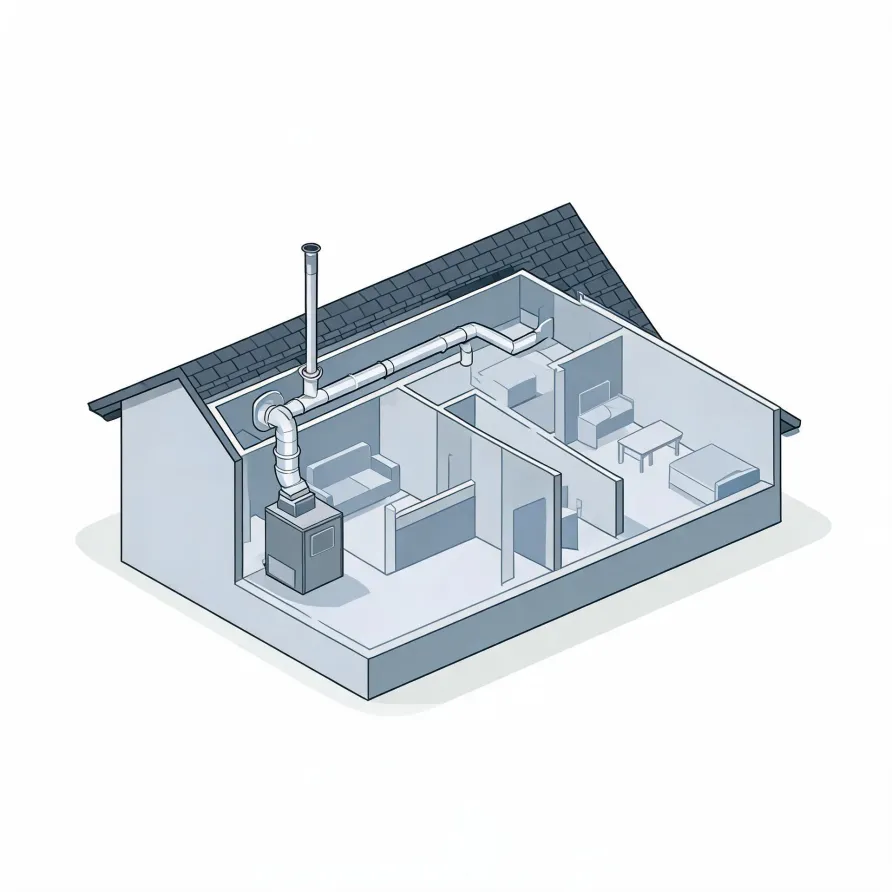
The heat exchanger sits at the core of the furnace cabinet, usually in a utility room, basement, or garage. It is the wall between combustion gases and the air your family breathes, so a crack there is serious. The burner assembly feeds it flame, and the ignitor is what lights that flame each cycle.
The blower motor and its wheel sit in the lower section of the cabinet and push conditioned air into the supply plenum. The flue or venting pipe runs from the top or back of the cabinet to the outside wall or roof. The control board ties all of it together, reading inputs from the thermostat and telling each component when to act.
The drawing shows a typical furnace layout, and a licensed contractor determines which components apply and what condition they are in for your specific home.
Find a contractor in San Benito CountySan Benito County, by the numbers
47 severe weather events were recorded in San Benito County, California between 2015 and 2024.
NOAA National Centers for Environmental Information, Storm Events Database, bulk CSV export, events 2015-01-01 through 2024-12-31.Half the homes in San Benito County, California were built in 1989 or earlier (2020-2024 ACS 5-year).
U.S. Census Bureau, 2020-2024 American Community Survey 5-Year EstimatesSan Benito County, California holds 21,322 housing units (2020-2024 ACS 5-year).
U.S. Census Bureau, 2020-2024 American Community Survey 5-Year EstimatesOwners occupy 67.9% of the occupied homes in San Benito County, California (2020-2024 ACS 5-year).
U.S. Census Bureau, 2020-2024 American Community Survey 5-Year EstimatesCodes & Standards Behind Furnace Repair in San Benito County, California5 sourced rules and standards
What HVAC Repair Looks Like in San Benito County
Non-weatherized gas furnaces manufactured on or after November 19, 2015 must reach 80.0 percent AFUE.
Non-weatherized oil-fired furnaces manufactured on or after November 19, 2015 must reach 83.0 percent AFUE.
Mobile home gas furnaces manufactured on or after November 19, 2015 must reach 80.0 percent AFUE.
Non-weatherized gas furnaces manufactured on or after December 18, 2028 must reach 95.0 percent AFUE, up from the 80.0 percent minimum that applies to units manufactured before that date.
Licensing and Legal Requirements in San Benito County, California
California requires a state contractor license: it is a misdemeanour to engage in the business of, or act in the capacity of, a contractor in California without one, unless the work is exempt.
Severe Weather Events in San Benito County
Extreme weather puts furnaces under stress they were not sized to absorb on a normal day. How often that happens here shapes how hard local equipment works and how quickly wear accumulates.
47 severe weather events, 2016–2024. Source: NOAA National Centers for Environmental Information, Storm Events Database.