Tell us about the job
Takes about a minute. No obligation.
A furnace repair quote in Colusa County starts with the burner assembly and heat exchanger, because those are the parts that cycle every heating season and accumulate wear where it counts. Homes in Colusa County, CA run heat about six months a year, from November through April. Each cycle stresses the heat exchanger through expansion and contraction, and a crack there goes unnoticed until combustion gases find a path into the living space. The ignition system takes the same repeated load. A contractor pulling a furnace apart here expects to find that wear concentrated in those three components, and prices the job around what they actually find.
Ductwork in a house this old was put in for whatever system came with it originally, and the furnace running in it now is unlikely to be that system. Half the homes in Colusa County, California were built in 1978 or earlier (2020-2024 ACS 5-year). When a repair opens up a furnace in stock like this, what decides how the job goes is parts availability: whether the heat exchanger, control board, or igniter a unit of that generation takes is still being made, or has to be sourced through a shrinking pool of suppliers. A contractor who finds the part is still in production quotes a different job than one who does not.
The Parts of a Furnace a Contractor Checks First
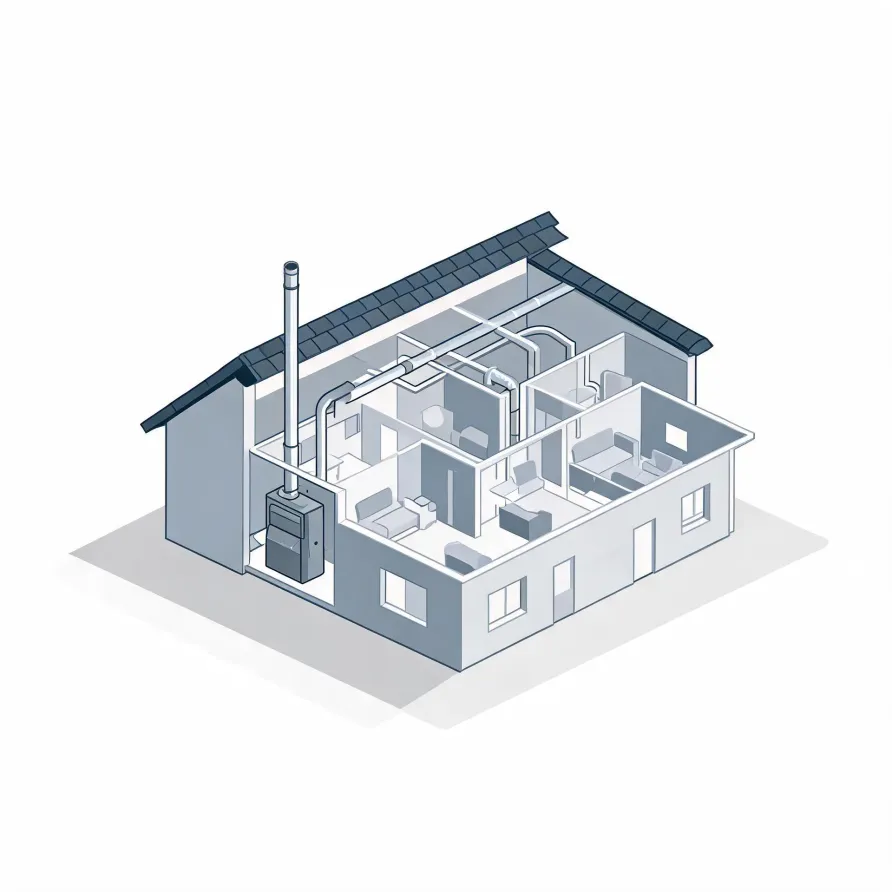
The furnace itself sits in a utility closet, basement, or garage and is the piece a contractor goes to first. Inside it, the heat exchanger is the part that fails most quietly and matters most when it does, because cracks there let combustion gases into living air. The burners, which fire below the heat exchanger, get checked whenever a furnace runs poorly or not at all.
The blower motor sits at the base of the furnace cabinet and pushes conditioned air into the supply plenum above it. The flue pipe runs from the top of the furnace to an exterior wall or roof and carries exhaust out of the house. The thermostat on an interior wall is where a contractor often starts, since a wiring fault or failed sensor there can mimic a furnace problem.
The drawing shows the general layout of a furnace system, and a licensed contractor determines which components apply to the specifics of your house.
Find a contractor in Colusa CountyColusa County by the Numbers
30 severe weather events were recorded in Colusa County, California between 2015 and 2024.
NOAA National Centers for Environmental Information, Storm Events Database, bulk CSV export, events 2015-01-01 through 2024-12-31.Half the homes in Colusa County, California were built in 1978 or earlier (2020-2024 ACS 5-year).
U.S. Census Bureau, 2020-2024 American Community Survey 5-Year EstimatesColusa County, California holds 8,211 housing units (2020-2024 ACS 5-year).
U.S. Census Bureau, 2020-2024 American Community Survey 5-Year EstimatesOwners occupy 62.2% of the occupied homes in Colusa County, California (2020-2024 ACS 5-year).
U.S. Census Bureau, 2020-2024 American Community Survey 5-Year EstimatesFurnace Repair Rules on the Books for Colusa County, California5 codes, standards & license rules
What Happens When a Contractor Comes Out
Non-weatherized gas furnaces manufactured on or after November 19, 2015 must reach 80.0 percent AFUE.
Non-weatherized oil-fired furnaces manufactured on or after November 19, 2015 must reach 83.0 percent AFUE.
Mobile home gas furnaces manufactured on or after November 19, 2015 must reach 80.0 percent AFUE.
Non-weatherized gas furnaces manufactured on or after December 18, 2028 must reach 95.0 percent AFUE, up from the 80.0 percent minimum that applies to units manufactured before that date.
Licensing Rules for HVAC Work in Colusa County, California
California requires a state contractor license: it is a misdemeanour to engage in the business of, or act in the capacity of, a contractor in California without one, unless the work is exempt.
Weather Events in Colusa County That Stress Heating Systems
Furnaces work harder when outdoor conditions swing to extremes, and that added load is where wear turns into repair calls. The chart below tracks recorded severe weather events in the county so you can see the pattern of stress your equipment faces.
30 severe weather events, 2016–2024. Source: NOAA National Centers for Environmental Information, Storm Events Database.