Tell us about the job
Takes about a minute. No obligation.
On a furnace repair call in Sutter County, a contractor's first look goes to the burner assembly, the heat exchanger, and the ignition system, because those are the parts that cycle every time the furnace fires. Homes in Sutter County, CA run heat about six months a year, from November through April. The igniter, in particular, degrades through repeated heating and cooling, and a long heating season pushes that cycle count high enough that igniter failure is one of the more common reasons a furnace stops lighting. Cracks in the heat exchanger follow the same pattern: they show up after years of thermal stress, not sudden impact.
Furnaces in a large share of Sutter County homes have been running long enough that the supply chain for their parts has thinned considerably. Half the homes in Sutter County, California were built in 1982 or earlier (2020-2024 ACS 5-year). A contractor who opens a heat exchanger or a control board on a system of that era may find that the exact component it needs has been superseded, discontinued, or is available only through specialty suppliers at longer lead times. That changes the repair scope in a concrete way: the job that looked like a same-week fix can stretch, and the cost of sourcing a legacy part sometimes reframes what the homeowner decides to do next.
The Parts of a Furnace a Contractor Checks First
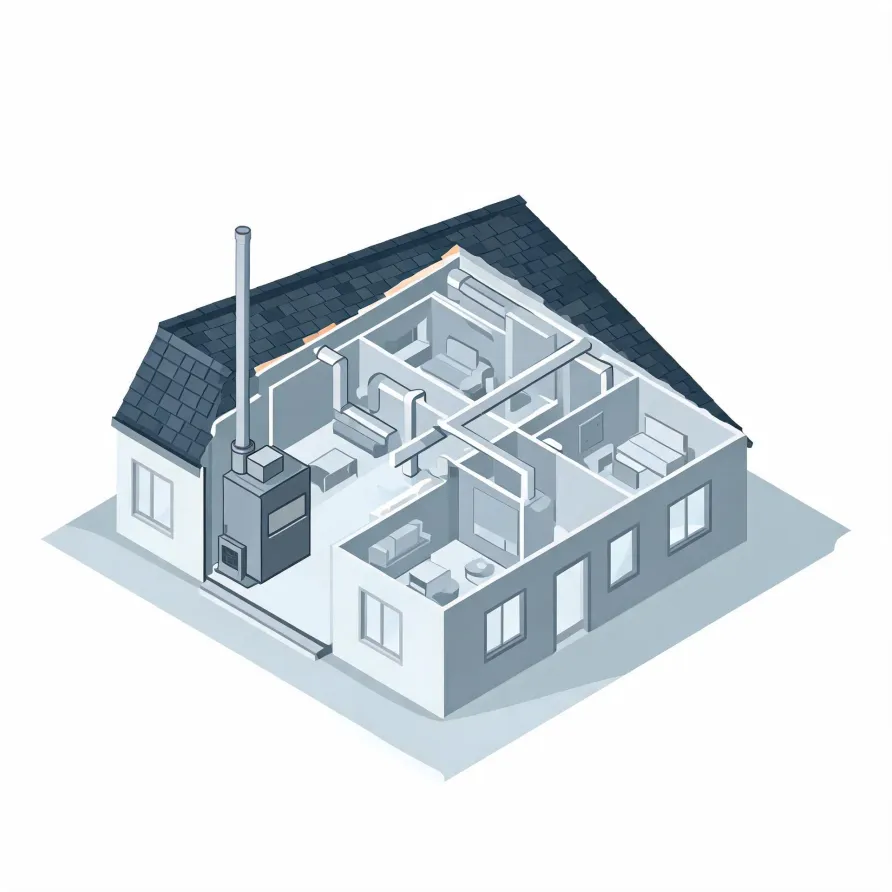
The heat exchanger sits at the core of the furnace cabinet, and it is where a contractor looks early. Cracks or corrosion there let combustion gases into the airstream, so any sign of damage stops the diagnostic cold. The burner assembly sits just below it, and a contractor checks the flame pattern and igniter before moving anywhere else.
The blower motor and its wheel sit at the base of the cabinet and push conditioned air out through the supply plenum. The control board runs behind the front panel and governs every timed sequence the furnace follows. When a furnace behaves erratically, short-cycles, or refuses to start, one of those two pieces is usually where the answer is.
The drawing shows a typical furnace layout, and a licensed contractor determines which components apply to the specific system in your home.
Find a contractor in Sutter CountySutter County, by the numbers
61 severe weather events were recorded in Sutter County, California between 2015 and 2024.
NOAA National Centers for Environmental Information, Storm Events Database, bulk CSV export, events 2015-01-01 through 2024-12-31.Half the homes in Sutter County, California were built in 1982 or earlier (2020-2024 ACS 5-year).
U.S. Census Bureau, 2020-2024 American Community Survey 5-Year EstimatesSutter County, California holds 34,798 housing units (2020-2024 ACS 5-year).
U.S. Census Bureau, 2020-2024 American Community Survey 5-Year EstimatesOwners occupy 61.3% of the occupied homes in Sutter County, California (2020-2024 ACS 5-year).
U.S. Census Bureau, 2020-2024 American Community Survey 5-Year EstimatesFurnace Repair Rules & Codes for Sutter County, California5 sourced standards and regulations
What HVAC Repair Looks Like in Sutter County
Non-weatherized gas furnaces manufactured on or after November 19, 2015 must reach 80.0 percent AFUE.
Non-weatherized oil-fired furnaces manufactured on or after November 19, 2015 must reach 83.0 percent AFUE.
Mobile home gas furnaces manufactured on or after November 19, 2015 must reach 80.0 percent AFUE.
Non-weatherized gas furnaces manufactured on or after December 18, 2028 must reach 95.0 percent AFUE, up from the 80.0 percent minimum that applies to units manufactured before that date.
Licensing Rules for HVAC Repair in Sutter County, California
California requires a state contractor license: it is a misdemeanour to engage in the business of, or act in the capacity of, a contractor in California without one, unless the work is exempt.
Weather Events in Sutter County That Stress HVAC Systems
Sutter County's climate puts real demand on furnaces. Each weather event logged here represents a period when heating equipment worked harder, and that workload is what drives wear, breakdowns, and repair calls.
61 severe weather events, 2016–2024. Source: NOAA National Centers for Environmental Information, Storm Events Database.