Tell us about the job
Takes about a minute. No obligation.
A furnace repair in Mendocino County starts with the parts that work hardest and longest: the burner, the heat exchanger, and the ignition system. Homes in Mendocino County, CA run heat about eight months a year, from October through May. That cycle puts real hours on the components that fire and extinguish with every heating call, and a cracked heat exchanger or a failing igniter has usually been degrading through several consecutive seasons before it surfaces as a cold house. A contractor diagnosing the system checks those components first, because that is where the wear lands.
Ductwork sized for earlier heating systems is what furnace contractors find inside much of this county's housing stock. Half the homes in Mendocino County, California were built in 1977 or earlier (2020-2024 ACS 5-year). When a furnace fails in a house that old, the repair scope turns on whether the components it takes are still manufactured. A blower motor or heat exchanger from that era may have no current equivalent, and a contractor has to determine that before a fix is possible, not after the unit is opened and the answer is already costing time.
The Parts of a Furnace a Contractor Checks First
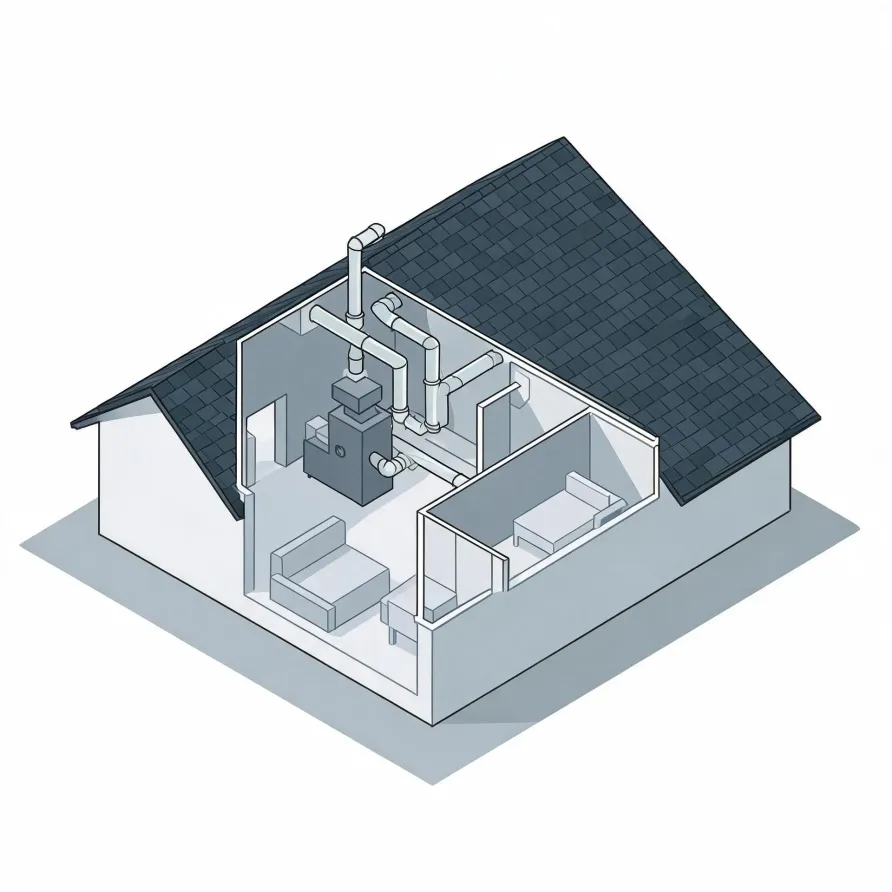
The heat exchanger sits at the center of the furnace cabinet and is the piece a contractor reaches for early in a repair call. Cracks or deposits here affect the whole system. The burner assembly sits just below it, mixing gas and igniting it, and a failed igniter or dirty burner is one of the most common reasons a furnace stops producing heat.
The blower motor and its fan wheel live in the lower section of the cabinet, pushing conditioned air into the supply side of the house. Alongside them sits the control board, which reads signals from the thermostat and tells every other component when to act. A fault in either one can shut the furnace down or make it behave erratically.
The drawing shows a typical furnace layout, and a licensed contractor will determine which components apply to the specific unit and installation in your home.
Find a contractor in Mendocino CountyMendocino County, by the numbers
89 severe weather events were recorded in Mendocino County, California between 2015 and 2024.
NOAA National Centers for Environmental Information, Storm Events Database, bulk CSV export, events 2015-01-01 through 2024-12-31.Half the homes in Mendocino County, California were built in 1977 or earlier (2020-2024 ACS 5-year).
U.S. Census Bureau, 2020-2024 American Community Survey 5-Year EstimatesMendocino County, California holds 41,675 housing units (2020-2024 ACS 5-year).
U.S. Census Bureau, 2020-2024 American Community Survey 5-Year EstimatesOwners occupy 61.7% of the occupied homes in Mendocino County, California (2020-2024 ACS 5-year).
U.S. Census Bureau, 2020-2024 American Community Survey 5-Year EstimatesCodes & Standards Governing Furnace Repair in Mendocino County, California5 sourced rules and standards
What HVAC Repair Looks Like in Mendocino County
Non-weatherized gas furnaces manufactured on or after November 19, 2015 must reach 80.0 percent AFUE.
Non-weatherized oil-fired furnaces manufactured on or after November 19, 2015 must reach 83.0 percent AFUE.
Mobile home gas furnaces manufactured on or after November 19, 2015 must reach 80.0 percent AFUE.
Non-weatherized gas furnaces manufactured on or after December 18, 2028 must reach 95.0 percent AFUE, up from the 80.0 percent minimum that applies to units manufactured before that date.
Licensing and Legal Requirements in Mendocino County, California
California requires a state contractor license: it is a misdemeanour to engage in the business of, or act in the capacity of, a contractor in California without one, unless the work is exempt.
Severe Weather Events in Mendocino County
Weather puts load on heating equipment. Each cycle of cold, wind, or sudden temperature swing is work a furnace has to absorb, and that accumulated stress shapes what repair needs look like in Mendocino County.
89 severe weather events, 2017–2024. Source: NOAA National Centers for Environmental Information, Storm Events Database.